

Has Marbella’s new PGOM been approved? Yes. Marbella’s Pleno gave definitive municipal approval to the new Plan General de Ordenación Municipal (PGOM) on 18 September 2026. However, approval is not the same as entry into force. The Ayuntamiento states that the PGOM becomes effective after its definitive resolution and Urban Planning Rules are published in the BOP Málaga, with effect from the following day.
Key facts: PGOM Marbella 2026
| Question | Current position |
|---|---|
| Has the PGOM been approved? | Yes. Definitively approved by Marbella Pleno on 18 September 2026. |
| Who approved it? | Ayuntamiento de Marbella, through the municipal Pleno |
| What does it replace? | The previous general planning framework dating from 1986 |
| Main legislation | Ley 7/2021, the LISTA, and its implementing regulations |
| Is it already in force? | As of 30 September 2026, the definitive PGOM resolution and Urban Planning Rules have not been identified in the BOP Málaga. The Ayuntamiento states that the plan will enter into force on the day after its publication. |
| What happens to the POU? | It remains a separate planning instrument under preparation |
| When will the POU be approved? | No definitive official approval date has been announced |
Last verified: 30 September 2026.
The Ayuntamiento describes the new PGOM as the first general municipal plan in Andalucía adapted to the Ley de Impulso para la Sostenibilidad del Territorio de Andalucía (LISTA). The Junta de Andalucía issued a favourable report on the final PGOM in February 2026, allowing the municipal approval process to proceed.
See the Ayuntamiento de Marbella’s official Nuevo Plan Municipal portal.
Important: This article reflects the position verified on 30 September 2026. Planning law and individual property circumstances can change. Always obtain independent legal advice and current municipal planning information before purchasing or developing land.
What exactly has Marbella approved?
The PGOM is Marbella’s general planning instrument under the new Andalusian planning system.
This is an important change for anyone who remembers the old terminology. Under LISTA, the traditional single-plan model has been replaced by two principal planning instruments: the Plan General de Ordenación Municipal (PGOM) and the Plan de Ordenación Urbana (POU).
The Ayuntamiento explains that the PGOM establishes the municipality’s general planning model, including the classification of land and the general organisation of the municipality.
Read the Ayuntamiento’s official explanation of the PGOM.
Marbella’s definitive PGOM documentation was published by the Ayuntamiento on 24 September 2026. The municipality describes this as the final version of the planning instrument, prepared after the final PGOM proposal and the ratification of the required sectoral reports.
What is the POU and how is it different from the PGOM?
The Plan de Ordenación Urbana (POU) is the more detailed urban-planning instrument.
In simple terms, the PGOM sets the municipality’s broad planning framework, while the POU covers detailed urban planning within the existing city.
| PGOM | POU |
|---|---|
| General municipal planning | Detailed urban planning |
| Establishes the overall planning model | Deals with detailed organisation of urban land |
| Establishes broad land classification and general planning determinations | Regulates detailed uses and building parameters within its scope |
| Definitively approved on 18 September 2026 | Still being processed |
| Awaiting publication for entry into force, subject to verification | No definitive approval date announced |
The two documents should not be treated as competing plans. The POU is intended to operate within the framework established by the PGOM.
The Ayuntamiento describes the POU as an instrument of detailed urban planning which studies, diagnoses and organises the existing city. It applies to suelo urbano (urban land), broadly corresponding to the existing urban area.
See the Ayuntamiento’s official POU explanation.
When did Marbella approve the new PGOM?
The Marbella Pleno gave definitive municipal approval to the PGOM on 18 September 2026.
The Ayuntamiento described the approval as the culmination of the process to replace the municipality’s previous general planning framework, which dates from 1986.
The Ayuntamiento subsequently published the definitive PGOM documents on its planning portal on 24 September 2026.
The municipal Pleno approved the definitive Marbella PGOM on 18 September 2026. Source: Ayuntamiento de Marbella.
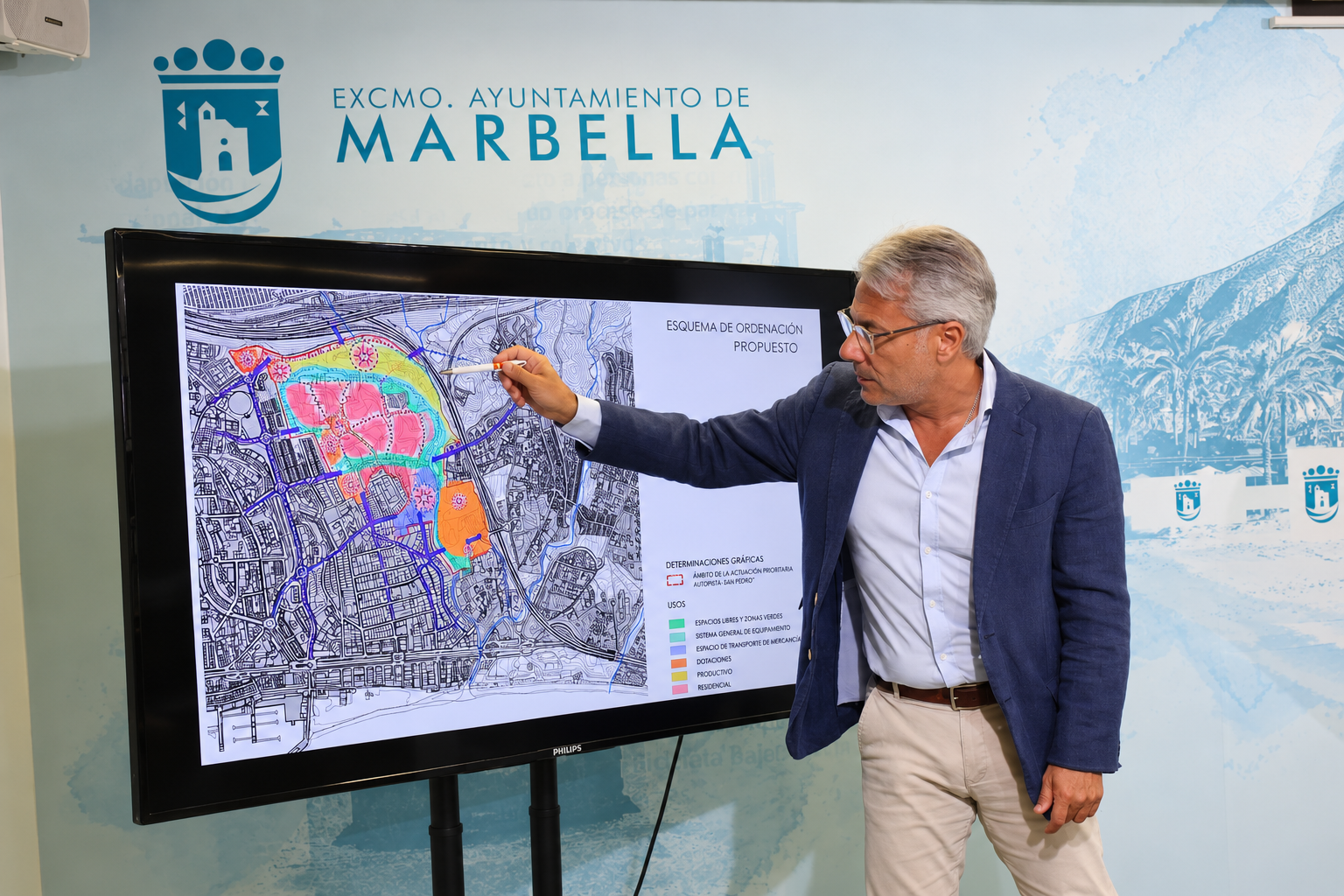 The municipal Pleno approved the definitive Marbella PGOM on 18 September 2026. Source: Ayuntamiento de Marbella.
View the official definitive PGOM documentation.
Is Marbella’s PGOM already in force?
This is the point that needs particular care.
Approval and entry into force are not the same event.
The Ayuntamiento’s official definitive-approval page states that, after publication in the BOP Málaga of the corresponding resolution and the Urban Planning Rules, the PGOM will fully take effect and enter into force the day after publication.
That means the date of the Pleno approval — 18 September — should not automatically be treated as the date on which the new planning framework became legally effective.
What is still pending?
Two particularly important items remain unfinished.
1. Publication of the PGOM
This is the immediate legal milestone.
The Ayuntamiento published the definitive PGOM documentation on 24 September 2026 and specifically states that the plan will become fully effective after publication in the BOP Málaga of the definitive resolution and its Urban Planning Rules.
Under the Ley 7/2021 (LISTA), publication is an essential part of the process by which an approved planning instrument acquires legal effect.
Read Ley 7/2021 (LISTA) on the official BOE website.
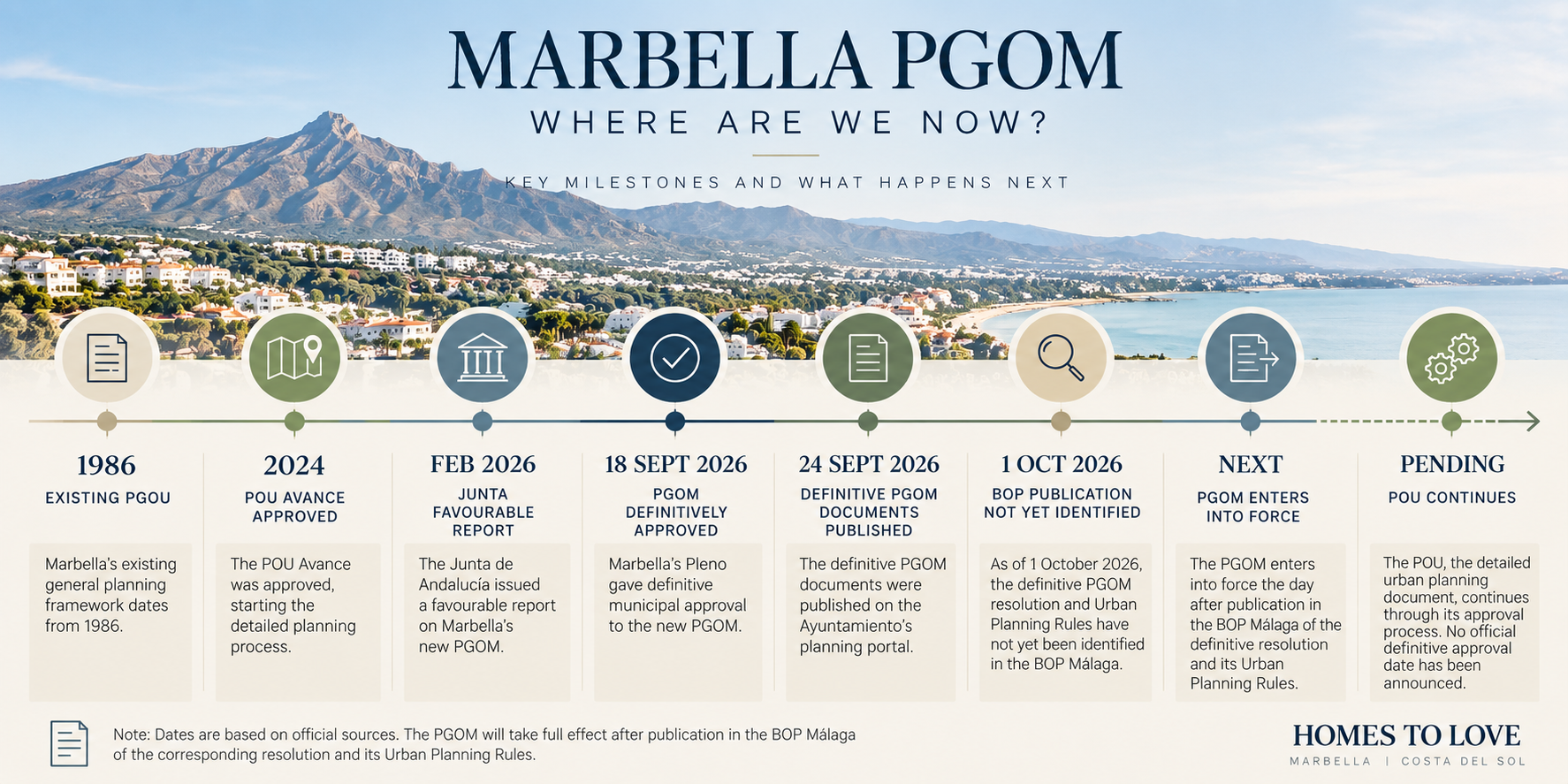
2. Completion and approval of the POU
The POU is further behind in the process.
The Ayuntamiento’s published procedure shows six main stages:
- Elaboration of the Avance
- Approval of the Avance
- Preparation of the document for initial approval
- Initial approval and public information
- Preparation of the final proposal
- Definitive approval
The POU Avance was approved in 2024. The municipality’s current POU documentation also records the environmental assessment process and the documento de alcance published in October 2025.
There is currently no definitive official approval date for the POU that we can responsibly give buyers.
See the current official POU procedure.
What rules apply while the POU is pending?
This is where buyers need to be particularly careful.
The absence of an approved POU does not mean that Marbella has no planning rules or that development is automatically frozen.
LISTA includes transitional provisions, and Marbella’s urban-planning department has published guidance explaining how land and existing planning arrangements are treated during the transition to the new planning system.
The practical question for a particular property is therefore:
What does the applicable planning framework say about this particular property, and which matters are already settled versus dependent on the POU or another future planning instrument?
This is why a general statement such as “the plot is urban” is not enough for a purchase decision.
What does the PGOM mean for buyers and owners?
Buying a resale property
For a normal resale purchase, the PGOM does not make the usual legal checks unnecessary.
A buyer should still establish:
- the property’s registered ownership;
- cadastral information;
- the current planning classification and applicable zoning;
- the legality of the existing building;
- whether extensions or alterations have the necessary planning authorisation;
- whether there are outstanding planning or enforcement proceedings;
- whether the property has the relevant occupation or use documentation; and
- whether the new PGOM changes the property’s planning position.
For buyers, the important point is that the approval of a new municipal plan does not replace property-specific due diligence.
Buying a plot
A plot should be treated differently from a completed home.
A seller’s description of land as “building land” is not itself a planning certificate.
Before exchanging contracts, a buyer should establish:
- the land classification;
- the applicable zoning;
- permitted use;
- buildability;
- height and occupation limits;
- minimum plot requirements;
- access and infrastructure requirements;
- whether it forms part of an urban transformation area;
- whether detailed planning is required; and
- whether the ability to build depends on the POU or another planning instrument.
For development land, these distinctions can materially affect what can actually be built.
Buying off-plan
Off-plan buyers should ask which planning instrument supports the development.

The fact that a development has been marketed or has received one planning approval does not automatically mean every subsequent planning and building requirement has been completed.
Ask to see:
- the planning documentation;
- the building licence or applicable authorisation;
- the approved project;
- the developer’s legal due diligence;
- the status of infrastructure and urbanisation obligations; and
- documentation relating to final occupation or use.
For completed units, buyers should also check the documentation relating to licencia or declaración responsable de primera ocupación, depending on the applicable procedure.
What about properties described as fuera de ordenación?
Fuera de ordenación means, broadly, that an existing building or installation is incompatible with the planning order now applicable to the land. This is not automatically the same thing as saying that the property was illegally built.
There is also the separate concept of asimilado al régimen de fuera de ordenación (AFO). This is a specific legal regime for certain existing irregular buildings where the relevant enforcement/restoration action can no longer be taken under the applicable rules.
Crucially, AFO status does not itself legalise an irregular building.
The distinction matters enormously in a purchase. A lawyer should establish why a property has its particular planning status, what documents support it, and what works, uses, or changes are legally possible.
Does the new PGOM legalise properties built without a licence?
No blanket legalisation should be assumed.
The new PGOM does not turn every historically irregular building into a fully legal building simply because the plan has been approved.
LISTA distinguishes between legally erected buildings that become incompatible with new planning and irregular buildings that may fall within an AFO regime. AFO status itself does not constitute legalisation.
For an individual property, the answer depends on its planning history, land classification, enforcement position, relevant dates and the precise provisions applying to the property.
This is an area where a property-specific legal and planning review is essential.
Can I still buy a plot or build in Marbella while the POU is pending?
Potentially, yes, but it depends on the land and the planning framework that applies to it.
The POU’s pending status does not create a blanket prohibition on buying property or carrying out development in Marbella.
However, “POU pending” should not be interpreted as “the current planning rules are irrelevant”.
For a plot, the important questions are whether there is sufficient current and effective planning to support the proposed development and whether any further detailed planning, urbanisation or transformation process is required.
For anything more complex than a straightforward purchase of an existing home, we recommend obtaining independent planning and legal advice before exchanging contracts.
What should buyers ask before purchasing?
For anyone buying land or a property where planning is an important part of the value, we recommend asking for written answers rather than relying on verbal assurances.
Questions for your independent lawyer
- What is the property’s current legal and planning status?
- Which planning instrument currently applies?
- Has the new PGOM entered into force?
- Does the PGOM alter the property’s classification or permitted use?
- Is the property affected by the future POU?
- Is it within an area requiring further urban transformation or detailed planning?
- Are there outstanding planning-enforcement proceedings?
- Is the building fully licensed and does the constructed reality match the approved plans?
- If it is described as fuera de ordenación or AFO, exactly what does that status permit?
- Can the proposed purchase, renovation, extension or redevelopment legally proceed?
Documents worth requesting
Depending on the property, this can include:
- Nota Simple from the Land Registry;
- cadastral documentation;
- current municipal planning information;
- building licence;
- approved building project;
- first occupation/use documentation;
- AFO documentation where relevant;
- planning-enforcement records;
- urbanisation documentation; and
- any available municipal reports concerning the property.
The Ayuntamiento de Marbella’s urban-planning section provides access to relevant procedures and documentation.
What should developers be watching?
For developers, the PGOM is potentially more significant than it is for a straightforward resale buyer because development depends on the interaction between general planning, detailed planning, execution and infrastructure.
The immediate priorities should be:
- Confirm when the PGOM becomes legally effective.
- Compare the definitive PGOM against the previous planning position for each development site.
- Identify which matters are settled by the PGOM and which require the POU or another planning instrument.
- Review sectoral constraints, including environmental, coastal, infrastructure, heritage and other applicable legislation.
A planning designation alone does not remove separate statutory constraints.
What happens over the next 6–12 months?
There is a difference between what we know and what we can reasonably expect to be processed.
The immediate PGOM milestone
The immediate legal milestone is still the publication of the definitive PGOM resolution and its Urban Planning Rules in the BOP Málaga. The Ayuntamiento states that, after that publication, the PGOM will take full effect and enter into force the following day.
As of 30 September 2026, we have checked the latest available BOP Málaga issue (No. 188, dated 30 September), and the definitive PGOM resolution and Urban Planning Rules have not yet been published there. The Marbella notice appearing in that issue relates instead to the urbanisation project for Sector URP-MB-2 “Tenis de Marbella”.
This means Marbella’s Pleno has definitively approved the PGOM, but the official publication required for it to enter into force has not yet been identified.
Last checked: 30 September 2026.
The POU
The POU continues through its own planning and environmental procedure.
The official municipal procedure provides for preparation of the initial document, initial approval, public information, final proposal and definitive approval.
However, no official definitive approval date has been announced, so it would be inappropriate to give buyers a specific month or quarter as though it were guaranteed.
Follow the official POU procedure here.
What are buyers asking?
In our view, the most useful approach during this transition is not to ask simply whether a property is “affected by the PGOM”. Almost every property is affected by a change in the municipal planning framework in some way.
The better question is:
What is the property’s legal and planning position today, what does the approved PGOM change, and what remains dependent on the POU or another future planning decision?
Open questions: what don’t we know yet?
Several points should remain open rather than being presented as settled facts.
1. Exact PGOM entry-into-force date
The Ayuntamiento has established the mechanism — publication followed by entry into force the next day — but the latest BOP Málaga publication must be checked.
2. Exact POU timetable
The POU is being processed, but no definitive official approval date has been identified.
3. Property-by-property consequences
The PGOM’s effect will vary according to the property’s location, classification, existing planning status and applicable detailed planning.
4. Treatment of individual irregular properties
The new PGOM does not provide a universal answer for every irregular building. Individual planning and legal histories remain important.
5. Future implementing instruments
The PGOM will operate alongside other planning instruments and sectoral legislation. Its approval is therefore not the end of Marbella’s planning process.
The bottom line for property buyers
Marbella has crossed an important planning milestone, but the phrase “PGOM approved” should not be confused with “everything is now settled”.
The municipal Pleno approved the definitive PGOM on 18 September 2026. The next immediate step is its official publication so that it can enter into force. Alongside that, the POU remains under preparation and will provide detailed urban planning for urban land within the framework established by the PGOM.
For buyers, this means the sensible approach remains property-specific.
Before committing to a purchase — particularly a plot, redevelopment opportunity or property with planning irregularities — obtain an independent lawyer’s review and up-to-date municipal planning information.
The most important document is not a sales brochure saying what a property could become.
It is the planning documentation showing what the property is legally permitted to be, what it can become, and under which planning instrument.
Sources & methodology
This article was researched and fact-checked using official Spanish planning and government sources, with information verified against the position available on 30 September 2026.
Our primary sources include:
- Ayuntamiento de Marbella — official PGOM and POU documentation, planning announcements and urban-planning procedures.
- Junta de Andalucía — official information on the PGOM approval process and environmental planning procedures.
- BOE — official text of Ley 7/2021 (LISTA) and provisions governing the PGOM, POU, publication and entry into force.
- BOP Málaga — checked for the official publication required for the PGOM to enter into force.
- Andalusian planning and environmental records — used to verify the status of the POU process.
Where information reported in the media differed from, or could not be independently confirmed against, an official source, we have not treated it as established fact.
Important: Planning status can change as documents are published or amended. The position described in this article was last checked on 30 September 2026. Always obtain current municipal planning information and independent legal advice before buying land, purchasing a property with planning considerations or starting a development.
Official sources
Ayuntamiento de Marbella — PGOM: Aprobación Definitiva
Ayuntamiento de Marbella — Definitive PGOM approval, 18 September 2026
Ayuntamiento de Marbella — Nuevo Plan Municipal
Ayuntamiento de Marbella — POU Procedure
Ayuntamiento de Marbella — POU Avance and documentation
BOE — Ley 7/2021, LISTA
Ayuntamiento de Marbella — Urbanismo
Ayuntamiento de Marbella — Urban Planning Licences and Procedures
Disclaimer: This article is intended as general information about Marbella’s planning framework and does not constitute legal, planning, tax or investment advice. Planning rules and individual circumstances vary. Buyers and owners should obtain independent legal advice and current municipal planning documentation before entering into a purchase, development or construction commitment.
Frequently Asked Questions
Has the new PGOM in Marbella been approved?
Yes. Marbella’s municipal Pleno gave definitive approval to the PGOM on 18 September 2026. The Ayuntamiento subsequently published the definitive planning documentation. The plan still requires the publication required for it to enter into force.
What is the difference between the PGOM and the POU?
The PGOM is the municipality’s general planning instrument and establishes the overall territorial and urban model. The POU provides detailed urban planning for urban land and must operate consistently with the PGOM.
Is the PGOM in force yet?
The Ayuntamiento states that the PGOM enters into force after publication of the definitive resolution and Urban Planning Rules, effective the following day. Check the latest BOP Málaga publication before stating that the plan is already legally effective.
When will the POU be approved?
No definitive official approval date has been identified. The POU remains in process and must pass further planning and environmental stages before definitive approval.
Does the new PGOM legalise properties built without a licence?
No blanket legalisation should be assumed. LISTA distinguishes between legally erected buildings that become incompatible with new planning and irregular buildings that may qualify for an asimilado a fuera de ordenación regime. AFO status does not itself legalise an irregular building.
Can I still buy a plot or build in Marbella while the POU is pending?
Potentially, yes. The POU’s pending status does not create a blanket ban. Whether a particular plot can be developed depends on its planning classification, applicable rules, development status, infrastructure requirements and whether further detailed planning is required.
How do I check a property’s planning status in Marbella?
Check the Land Registry and cadastral information, obtain current municipal planning information and compare the existing building with authorised planning and construction documentation. For a purchase, an independent lawyer should review the complete planning position.
Does the PGOM mean Marbella’s old planning system has disappeared immediately?
Not quite. The PGOM was definitively approved in September 2026 and is intended to replace the previous general planning framework, but it does not acquire legal effect simply because the Pleno voted to approve it. Publication is required before it enters into force.